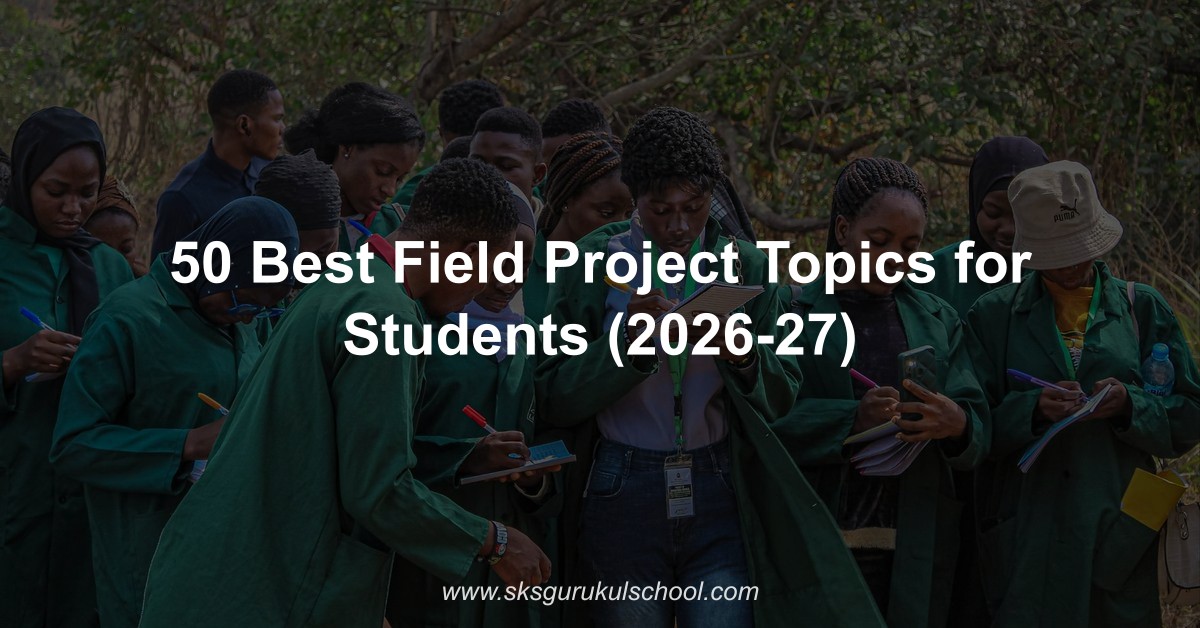
A field project is one of the best ways for students to learn beyond the classroom. Instead of just reading textbooks, you go out into the real world and study something firsthand.
Field projects help you understand how things actually work — in your village, city, school, or environment. They make learning meaningful and practical.
Whether you are in Class 10, Class 11, Class 12, or college, a well-chosen field project can boost your grades and give you real skills. It also shows teachers that you can think independently.
In this article, we have listed 50 of the best field project topics for students across five major subject areas — science, social studies, economics, agriculture, and health.
Must Read: 25 Research Project Ideas for Students
Why Field Projects Are Important for Students
Field projects connect classroom knowledge to the real world. When you visit a site, collect data, and observe things directly, you remember them far better than anything you read in a book.
They also help you develop important life skills. Through fieldwork, students learn how to plan, observe, record data, work in teams, and present findings clearly — skills that are useful in every career.
Teachers and examiners value field projects because they show original effort. A good field project can significantly improve your overall score and make your portfolio stand out.
- Builds observation skills — You learn to notice details that matter.
- Develops research habits — You practice collecting and analyzing real data.
- Improves communication — Writing and presenting your findings sharpens your language.
- Encourages teamwork — Many field projects are done in groups, teaching collaboration.
- Boosts confidence — Completing a real-world project makes students feel capable and motivated.
Quick Overview: 50 Field Project Topics
| # | Topic | Subject | Level |
|---|---|---|---|
| 1 | Water Quality Testing in Local Sources | Science & Environment | School/College |
| 2 | Air Pollution Study Near Busy Roads | Science & Environment | School/College |
| 3 | Biodiversity Survey of a Local Park | Science & Environment | School/College |
| 4 | Soil Erosion and Conservation Methods | Science & Environment | College |
| 5 | Effect of Plastic Waste on Local Water Bodies | Science & Environment | School/College |
| 6 | Study of Noise Pollution in Urban Areas | Science & Environment | School |
| 7 | Solar Energy Use in Homes and Schools | Science & Environment | School/College |
| 8 | Rainwater Harvesting Practices in the Community | Science & Environment | School/College |
| 9 | Deforestation and Its Effects on Local Wildlife | Science & Environment | College |
| 10 | Composting and Waste Management at School | Science & Environment | School |
| 11 | Population Distribution in a Local Area | Social Studies & Geography | School/College |
| 12 | Land Use Mapping of the Neighbourhood | Social Studies & Geography | School/College |
| 13 | Migration Patterns in a Village or Town | Social Studies & Geography | College |
| 14 | Study of Local Cultural Practices and Traditions | Social Studies & Geography | School/College |
| 15 | Impact of Urbanisation on a Small Town | Social Studies & Geography | College |
| 16 | Traffic Flow and Road Conditions Study | Social Studies & Geography | School |
| 17 | Study of Historical Monuments in the Region | Social Studies & Geography | School/College |
| 18 | Gender Roles in a Rural vs Urban Community | Social Studies & Geography | College |
| 19 | Access to Education in Nearby Villages | Social Studies & Geography | College |
| 20 | Mapping Local Public Amenities and Infrastructure | Social Studies & Geography | School/College |
| 21 | Survey of Small Business Owners in Local Market | Economics & Commerce | School/College |
| 22 | Price Variation of Essential Goods in Local Markets | Economics & Commerce | School/College |
| 23 | Impact of GST on Small Traders | Economics & Commerce | College |
| 24 | Consumer Awareness in a Local Shopping Area | Economics & Commerce | School/College |
| 25 | Women Entrepreneurs in the Local Area | Economics & Commerce | College |
| 26 | Study of Self-Help Groups (SHGs) in Villages | Economics & Commerce | College |
| 27 | Digital Payment Adoption Among Local Shopkeepers | Economics & Commerce | School/College |
| 28 | Employment Patterns in a Local Industrial Area | Economics & Commerce | College |
| 29 | Savings and Investment Habits of Local Families | Economics & Commerce | College |
| 30 | Street Vendors and Informal Economy Study | Economics & Commerce | School/College |
| 31 | Types of Crops Grown in the Local Area | Agriculture & Rural Studies | School/College |
| 32 | Use of Chemical Fertilisers vs Organic Farming | Agriculture & Rural Studies | College |
| 33 | Irrigation Methods Used by Local Farmers | Agriculture & Rural Studies | School/College |
| 34 | Farmer Income and Crop Losses Due to Weather | Agriculture & Rural Studies | College |
| 35 | Role of Cooperative Societies in Farming | Agriculture & Rural Studies | College |
| 36 | Animal Husbandry Practices in the Village | Agriculture & Rural Studies | School/College |
| 37 | Impact of Middlemen on Farmers’ Income | Agriculture & Rural Studies | College |
| 38 | Traditional vs Modern Farming Tools | Agriculture & Rural Studies | School/College |
| 39 | Soil Health and Fertility in Local Farmland | Agriculture & Rural Studies | College |
| 40 | Water Usage Patterns in Agricultural Areas | Agriculture & Rural Studies | School/College |
| 41 | Malnutrition and Diet Survey in a Local School | Health & Community | School/College |
| 42 | Hygiene and Sanitation Practices in a Village | Health & Community | School/College |
| 43 | Awareness of Common Diseases in the Community | Health & Community | School/College |
| 44 | Use of Government Health Schemes in Rural Areas | Health & Community | College |
| 45 | Mental Health Awareness Among Teenagers | Health & Community | School/College |
| 46 | Access to Clean Drinking Water in the Area | Health & Community | School/College |
| 47 | Tobacco and Alcohol Use Among Youth | Health & Community | College |
| 48 | Child Vaccination Rates in a Nearby Village | Health & Community | College |
| 49 | Study of Elderly Care in Urban Families | Health & Community | College |
| 50 | Role of Anganwadi Centres in Child Development | Health & Community | School/College |
50 Best Field Project Topics for Students
Science & Environment Field Project Topics
1. Water Quality Testing in Local Sources
Description: Test and compare the quality of water from rivers, wells, taps, and ponds in your area. Find out if the water is safe for drinking or daily use.
Best For: Class 10-12 / College
What You Study: Water pollution levels, pH, contamination sources, and safety standards.
2. Air Pollution Study Near Busy Roads
Description: Observe and record air quality at different times of day near heavy traffic areas. Compare data with quieter residential zones.
Best For: Class 10-12 / College
What You Study: Causes of air pollution, effect of vehicles, health risks, and possible solutions.
3. Biodiversity Survey of a Local Park
Description: Identify and record the variety of plants, birds, and insects found in a nearby park or open land. Create a simple biodiversity chart.
Best For: Class 10-12 / College
What You Study: Species identification, habitat observation, and importance of biodiversity.
4. Soil Erosion and Conservation Methods
Description: Study areas in your locality where soil erosion is visible and find out what causes it. Explore methods being used or recommended to prevent it.
Best For: College
What You Study: Types of soil erosion, impact on land fertility, and conservation techniques.
5. Effect of Plastic Waste on Local Water Bodies
Description: Visit a local pond, lake, or stream and document how plastic waste is affecting it. Interview locals and measure waste levels if possible.
Best For: Class 10-12 / College
What You Study: Plastic pollution, its effect on aquatic life, and steps for waste management.
6. Study of Noise Pollution in Urban Areas
Description: Measure and compare noise levels in different parts of your town — near markets, hospitals, schools, and residential areas.
Best For: Class 10-12
What You Study: Sources of noise pollution, decibel levels, health effects, and legal standards.
7. Solar Energy Use in Homes and Schools
Description: Survey how many households or institutions in your area use solar panels. Find out the benefits and barriers to solar energy adoption.
Best For: Class 10-12 / College
What You Study: Renewable energy, cost savings, government schemes, and awareness levels.
8. Rainwater Harvesting Practices in the Community
Description: Find out how many homes or buildings in your area practise rainwater harvesting. Study the methods used and their effectiveness.
Best For: Class 10-12 / College
What You Study: Water conservation, storage methods, and community awareness.
9. Deforestation and Its Effects on Local Wildlife
Description: Study a nearby area where trees have been cut and observe how it has changed the local environment and affected animals or birds.
Best For: College
What You Study: Causes of deforestation, ecological impact, and importance of reforestation.
10. Composting and Waste Management at School
Description: Set up a small composting project at school using vegetable waste and study how it reduces solid waste. Compare with regular waste disposal methods.
Best For: Class 10-12
What You Study: Organic waste management, composting process, and environmental benefits.
Social Studies & Geography Field Project Topics
11. Population Distribution in a Local Area
Description: Study how the population is spread across different wards or zones in your town or village. Use surveys and observation to record findings.
Best For: Class 10-12 / College
What You Study: Population density, demographic patterns, and factors affecting settlement.
12. Land Use Mapping of the Neighbourhood
Description: Create a hand-drawn or digital map showing how land in your area is used — for homes, shops, schools, agriculture, or open space.
Best For: Class 10-12 / College
What You Study: Types of land use, urban planning, and changes in land patterns over time.
13. Migration Patterns in a Village or Town
Description: Interview families in a village or urban colony to understand who has migrated, where they went, and why. Record patterns and reasons.
Best For: College
What You Study: Push and pull factors of migration, social effects, and economic impact.
14. Study of Local Cultural Practices and Traditions
Description: Document the festivals, rituals, food, and customs of a particular community in your area. Explore how these traditions are changing over time.
Best For: Class 10-12 / College
What You Study: Cultural heritage, social identity, and impact of modernisation on traditions.
15. Impact of Urbanisation on a Small Town
Description: Study how a nearby small town has changed due to urbanisation — in terms of buildings, population, jobs, and lifestyle — over the past decade.
Best For: College
What You Study: Urban growth, infrastructure changes, and social effects of rapid development.
16. Traffic Flow and Road Conditions Study
Description: Count vehicles and observe road conditions at different intersections in your town at peak and non-peak hours. Analyse congestion points.
Best For: Class 10-12
What You Study: Traffic management, road safety issues, and urban infrastructure planning.
17. Study of Historical Monuments in the Region
Description: Visit and document historical monuments or heritage sites in your district. Record their condition, visitor numbers, and local awareness.
Best For: Class 10-12 / College
What You Study: Local history, conservation status, tourism potential, and community awareness.
18. Gender Roles in a Rural vs Urban Community
Description: Compare how gender roles differ between a rural village and an urban neighbourhood through interviews and observations.
Best For: College
What You Study: Social norms, gender equality, education access, and changing roles in modern India.
19. Access to Education in Nearby Villages
Description: Visit schools in nearby villages to study enrolment rates, dropout rates, and quality of education. Interview parents, students, and teachers.
Best For: College
What You Study: Education inequality, government schemes, and barriers to schooling in rural India.
20. Mapping Local Public Amenities and Infrastructure
Description: Survey your area to identify and map public facilities like hospitals, parks, post offices, banks, and bus stops. Evaluate how accessible they are.
Best For: Class 10-12 / College
What You Study: Urban planning, public service distribution, and civic infrastructure awareness.
Economics & Commerce Field Project Topics
21. Survey of Small Business Owners in Local Market
Description: Interview 15–20 small business owners in a local market about their income, challenges, and business practices. Analyse patterns in their responses.
Best For: Class 10-12 / College
What You Study: Micro-entrepreneurship, local economy, and challenges for small businesses.
22. Price Variation of Essential Goods in Local Markets
Description: Record and compare the prices of basic items like rice, oil, vegetables, and milk across different shops or markets in your area over a period of time.
Best For: Class 10-12 / College
What You Study: Price fluctuations, inflation, supply-demand dynamics, and market behaviour.
23. Impact of GST on Small Traders
Description: Interview small traders and shop owners to understand how the Goods and Services Tax has affected their business costs and sales.
Best For: College
What You Study: Taxation policy, business compliance, and economic effects of GST on informal trade.
24. Consumer Awareness in a Local Shopping Area
Description: Survey shoppers to find out how aware they are of their consumer rights, product labels, expiry dates, and return policies.
Best For: Class 10-12 / College
What You Study: Consumer rights, awareness levels, role of consumer protection laws, and market literacy.
25. Women Entrepreneurs in the Local Area
Description: Identify and interview women who run their own businesses — big or small — in your locality. Explore their journey, challenges, and success stories.
Best For: College
What You Study: Women empowerment, entrepreneurship, social challenges, and economic independence.
26. Study of Self-Help Groups (SHGs) in Villages
Description: Visit and study a women’s Self-Help Group in a nearby village. Learn how it functions, its savings model, and its impact on members’ lives.
Best For: College
What You Study: Microfinance, collective savings, women empowerment, and rural development.
27. Digital Payment Adoption Among Local Shopkeepers
Description: Survey local shopkeepers to see how many use UPI, QR codes, or digital wallets. Find out what encourages or discourages digital payments.
Best For: Class 10-12 / College
What You Study: Digital economy, financial literacy, technology adoption, and cashless transactions.
28. Employment Patterns in a Local Industrial Area
Description: Study the types of jobs available in a local industrial zone and who fills them. Explore skill requirements, wages, and working conditions.
Best For: College
What You Study: Labour market, types of employment, wages, and industrial economy.
29. Savings and Investment Habits of Local Families
Description: Interview families in your neighbourhood about how they save money — in banks, post offices, gold, or other ways. Analyse their financial habits.
Best For: College
What You Study: Personal finance, savings behaviour, investment awareness, and financial planning.
30. Street Vendors and Informal Economy Study
Description: Study street vendors in a busy area — their income, challenges, licensing issues, and role in the local economy. Conduct structured interviews.
Best For: Class 10-12 / College
What You Study: Informal sector, urban livelihoods, regulatory challenges, and socio-economic status.
Agriculture & Rural Studies Field Project Topics
31. Types of Crops Grown in the Local Area
Description: Visit farms in a nearby village and document the types of crops grown in different seasons. Find out why farmers choose specific crops.
Best For: Class 10-12 / College
What You Study: Crop patterns, seasonal farming, soil suitability, and market demand.
32. Use of Chemical Fertilisers vs Organic Farming
Description: Compare fields using chemical fertilisers with those using organic methods. Interview farmers about costs, yields, and long-term effects on soil.
Best For: College
What You Study: Soil health, farming costs, sustainability, and awareness of organic practices.
33. Irrigation Methods Used by Local Farmers
Description: Study the different irrigation methods — drip, canal, tube well, or rain-fed — used by farmers in your area and compare their efficiency.
Best For: Class 10-12 / College
What You Study: Water management, irrigation technology, water use efficiency, and farmer challenges.
34. Farmer Income and Crop Losses Due to Weather
Description: Interview farmers about how weather events like floods, droughts, or unseasonal rain have impacted their crops and income in recent years.
Best For: College
What You Study: Climate impact on agriculture, farmer distress, crop insurance, and government support.
35. Role of Cooperative Societies in Farming
Description: Study a local agricultural cooperative society and find out how it helps farmers with seeds, credit, marketing, and equipment.
Best For: College
What You Study: Cooperative model, collective farming benefits, and rural development.
36. Animal Husbandry Practices in the Village
Description: Visit village households that keep cattle, poultry, or goats and study their rearing practices, income from animals, and challenges faced.
Best For: Class 10-12 / College
What You Study: Livestock management, rural income sources, and veterinary support availability.
37. Impact of Middlemen on Farmers’ Income
Description: Study how brokers and middlemen in the agricultural supply chain affect the price farmers receive for their produce. Interview farmers and traders.
Best For: College
What You Study: Agricultural marketing, supply chain economics, and farmer exploitation.
38. Traditional vs Modern Farming Tools
Description: Compare traditional farming tools like the wooden plough with modern equipment like tractors. Find out which farmers use which and why.
Best For: Class 10-12 / College
What You Study: Agricultural technology, cost and efficiency of tools, and adoption of modern practices.
39. Soil Health and Fertility in Local Farmland
Description: Collect soil samples from different types of farmland and test for fertility indicators like pH, nitrogen, and organic content. Compare results.
Best For: College
What You Study: Soil science, testing methods, fertility management, and impact of over-farming.
40. Water Usage Patterns in Agricultural Areas
Description: Study how much water is used by farmers for different crops and compare it to recommended levels. Find out if water is being used efficiently.
Best For: Class 10-12 / College
What You Study: Water conservation, crop-specific water needs, and sustainable farming practices.
Health & Community Field Project Topics
41. Malnutrition and Diet Survey in a Local School
Description: Survey students in a local government school about their daily diet, meal frequency, and body weight. Identify signs of malnutrition if present.
Best For: Class 10-12 / College
What You Study: Nutritional deficiencies, diet habits, midday meal effectiveness, and child health.
42. Hygiene and Sanitation Practices in a Village
Description: Visit households in a village and observe or survey their sanitation habits — toilet use, handwashing, waste disposal, and access to clean water.
Best For: Class 10-12 / College
What You Study: Sanitation levels, impact on health, and awareness of hygiene practices.
43. Awareness of Common Diseases in the Community
Description: Survey community members about their knowledge of common diseases like dengue, malaria, tuberculosis, and diabetes — their causes, symptoms, and prevention.
Best For: Class 10-12 / College
What You Study: Health literacy, disease prevention awareness, and community health education.
44. Use of Government Health Schemes in Rural Areas
Description: Survey rural families about their knowledge and use of government health programmes like Ayushman Bharat, Janani Suraksha Yojana, or PMJAY.
Best For: College
What You Study: Public health policy, scheme awareness, access barriers, and implementation gaps.
45. Mental Health Awareness Among Teenagers
Description: Conduct an anonymous survey among school or college students about stress, anxiety, exam pressure, and mental well-being. Analyse the results.
Best For: Class 10-12 / College
What You Study: Mental health issues in youth, awareness levels, and need for counselling support.
46. Access to Clean Drinking Water in the Area
Description: Survey households in both urban and rural parts of your area to find out their source of drinking water and whether it meets safety standards.
Best For: Class 10-12 / College
What You Study: Water supply infrastructure, water safety, health risks, and government schemes like Jal Jeevan Mission.
47. Tobacco and Alcohol Use Among Youth
Description: Conduct a confidential survey among college students or young adults in your area to study tobacco and alcohol use patterns, awareness of risks, and social influences.
Best For: College
What You Study: Substance use trends, health consequences, peer pressure, and prevention awareness.
48. Child Vaccination Rates in a Nearby Village
Description: Visit a village health centre and talk to ASHA workers or parents to find out vaccination coverage for children under five. Identify gaps and reasons.
Best For: College
What You Study: Immunisation coverage, barriers to vaccination, and public health effectiveness.
49. Study of Elderly Care in Urban Families
Description: Interview elderly people and their families in urban areas to study how senior citizens are cared for, their social life, health access, and emotional well-being.
Best For: College
What You Study: Ageing population, eldercare challenges, family structures, and social support systems.
50. Role of Anganwadi Centres in Child Development
Description: Visit an Anganwadi centre in your area and study its role in providing nutrition, early education, and health services to children under six and pregnant women.
Best For: Class 10-12 / College
What You Study: ICDS programme, child nutrition, early childhood education, and government welfare schemes.
Tips for Doing a Good Field Project
- Plan before you go: Decide your topic, area, and method of data collection before visiting the field. Prepare a questionnaire or checklist in advance.
- Take proper notes: Always carry a notebook and pen. Write down everything you observe, hear, or measure. Don’t rely on memory alone.
- Take photos and videos: Visual evidence makes your project stronger. Always ask for permission before photographing people.
- Be respectful: When speaking to farmers, traders, or community members, be polite, patient, and thankful. Never force anyone to answer.
- Analyse your data honestly: Present your findings as they are — don’t change data to match what you expected. Even unexpected results are valuable.
- Present clearly: Use tables, charts, and maps to make your project easy to read. A well-organised project always gets better marks.
Frequently Asked Questions
Q1. What is a field project for students?
A field project is a practical assignment where students go out of the classroom to study a topic in the real world — through observation, surveys, interviews, or experiments.
Q2. Which class is field project useful for?
Field projects are useful for students from Class 10 all the way to college. Many boards like CBSE, ICSE, and state boards require field or practical projects as part of assessments.
Q3. How long should a field project be?
Typically, a field project report should be 10–20 pages including introduction, methodology, findings, analysis, conclusion, and photographs. Check your school’s specific guidelines.
Q4. Can I do a field project alone or do I need a group?
Both are possible. Some projects work better in groups — like surveys — while others like observational studies can be done individually. Your teacher will usually guide you.
Q5. How do I choose the best field project topic?
Choose a topic that is relevant to your subject, easy to study in your local area, and genuinely interesting to you. A topic you care about will always produce a better project.
Also Read: SST Project Ideas for Students
Conclusion
Field projects are one of the most rewarding parts of student life. They push you to step outside, ask questions, and discover answers on your own — making you a more confident and capable learner.
With 50 carefully chosen field project topics across science, social studies, economics, agriculture, and health, you now have plenty of great options to choose from. Pick the one that fits your subject, your location, and your interest.
Start planning your field project today. Talk to your teacher, choose your topic from this list, and go out there and explore. The real world is the best classroom there is — and your project could make a real difference in your grades and your growth.