Education shapes individuals, societies, and cultures. Throughout history, different systems of learning have influenced how knowledge is passed from one generation to the next.
In India, two distinct approaches stand out: the traditional Gurukul system and today’s modern schooling system.
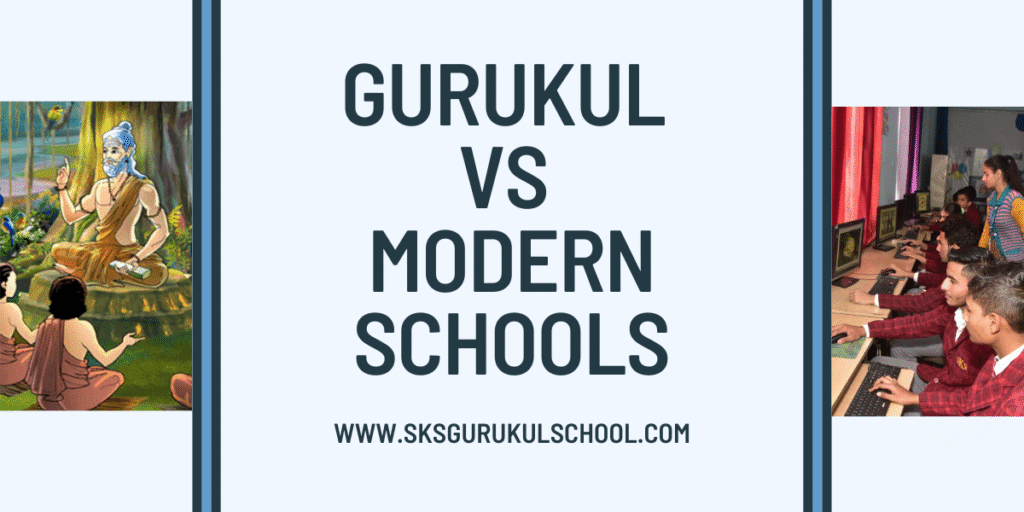
Both systems (Gurukul vs Modern Schools) have their unique strengths and limitations.
While Gurukuls were rooted in holistic, value-based learning, modern schools emphasize structured curricula, technological integration, and global competitiveness.
To understand their impact on education, it is essential to compare them in depth.
Must Read: Values and Ethics Taught in Gurukul Education
Understanding the Gurukul System
The Gurukul system was an ancient Indian form of education that emphasized close interaction between teacher and student.
Students (called shishyas) lived with their teacher (guru) in an ashram-like environment, often in remote areas away from urban distractions.
Key Features of the Gurukul System
- Residential Learning: Students lived with the guru, learning not only academic subjects but also discipline, self-reliance, and life skills.
- Holistic Education: Knowledge was not limited to books. Students learned philosophy, mathematics, astronomy, medicine, martial arts, music, and spiritual practices.
- Character Building: The focus was on shaping a person’s character, ethics, and values, rather than only imparting academic knowledge.
- Teacher-Student Bond: The guru was both mentor and guide, fostering personalized learning.
- Practical Orientation: Emphasis was placed on applying knowledge in real life, from managing nature to performing duties responsibly.
The Gurukul system was deeply tied to India’s cultural and spiritual traditions, ensuring education was not only about livelihood but also about living with purpose.
Understanding Modern Schools
Modern schools follow structured, institution-based learning models introduced during the colonial era and further shaped by global educational trends.
They are characterized by standardized curricula, classroom teaching, and examinations.
Key Features of Modern Schools
- Structured Curriculum: Subjects are taught systematically, divided into grades and levels.
- Institutional Setup: Schools operate as organizations with infrastructure, timetables, and administrative frameworks.
- Focus on Academic Achievement: Success is measured through exams, grades, and competitive tests.
- Technological Integration: Modern schools make use of digital tools, smart classrooms, and online learning platforms.
- Career Orientation: The ultimate goal is preparing students for higher education and employment opportunities.
Modern schooling has evolved rapidly with globalization and technology, creating opportunities for large-scale, inclusive education.
Historical Background
1. Origins of Gurukul
The Gurukul system dates back to the Vedic period (around 1500–500 BCE). Knowledge was transmitted orally through scriptures like the Vedas and Upanishads. Students served their gurus as part of their learning, performing daily chores and assisting in the household, instilling humility and discipline.
2. Evolution of Modern Schools
Modern schooling in India began during British rule in the 19th century. Lord Macaulay’s “Minute on Indian Education” (1835) emphasized English education and a structured school system modeled on the West. Post-independence, India adapted global practices and expanded schooling through government policies like the Right to Education Act.
Core Philosophy
Gurukul Philosophy
The Gurukul model aimed at integral development—shaping body, mind, and spirit. The purpose was not only to create scholars but also responsible individuals who upheld dharma (righteousness).
Modern School Philosophy
Modern schools emphasize standardized knowledge and skill development to meet economic and professional demands. The philosophy centers on preparing students for higher education, global competition, and career success.
Must Read: Brahmacharya in Student Life
Curriculum and Teaching Methods
1. Gurukul Curriculum
- Scriptures (Vedas, Upanishads, epics)
- Logic, grammar, literature
- Mathematics and astronomy
- Medicine (Ayurveda)
- Martial arts and weapon training
- Music, dance, and arts
- Life skills and moral education
2. Modern School Curriculum
- Languages (English, regional, foreign)
- Science (physics, chemistry, biology)
- Mathematics and computer science
- Social studies (history, civics, geography)
- Arts, sports, and extracurriculars
- Life skills and vocational courses
While Gurukul learning was fluid and personalized, modern schools follow a uniform syllabus designed by educational boards.
Teacher-Student Relationship
Gurukul
The relationship was sacred, like parent and child. The guru was a lifelong mentor, shaping the student’s values beyond academics.
Modern Schools
Teachers play the role of instructors within a professional framework. While mentorship exists, the bond is often limited by time, large class sizes, and formal boundaries.
Lifestyle and Discipline
Gurukul
Students lived simply, often in rural settings, with limited material possessions. Discipline was strict, focusing on self-control, service, and respect.
Modern Schools
Students attend schools for fixed hours and return home. Discipline varies by institution, and lifestyle is influenced by technology, peer culture, and urbanization.
Accessibility and Inclusivity
Gurukul
Traditionally, Gurukul education was limited to certain sections of society, often excluding marginalized communities and women (though there were exceptions).
Modern Schools
Modern education strives for inclusivity through government policies, co-education, scholarships, and special education for differently-abled students.
Advantages of Gurukul System
- Holistic Growth: Equal focus on physical, mental, and spiritual development.
- Personalized Learning: Small student groups allowed tailored guidance.
- Character and Values: Emphasis on discipline, ethics, and responsibility.
- Practical Knowledge: Learning connected directly with real-life experiences.
- Strong Teacher Bond: Students received lifelong mentorship.
Advantages of Modern Schools
- Mass Education: Ability to educate millions at scale.
- Technological Use: Access to digital resources and global knowledge.
- Inclusivity: Education available to all genders, communities, and abilities.
- Global Relevance: Prepares students for international opportunities.
- Career Orientation: Pathway to higher studies and professional careers.
Limitations of Gurukul System
- Restricted access for marginalized groups.
- Lack of written documentation and standardization.
- Dependent on the guru’s personal knowledge.
- Less exposure to global developments.
- Unsuitable for mass education in today’s scale.
Limitations of Modern Schools
- Overemphasis on exams and grades.
- Reduced focus on values and ethics.
- Limited teacher-student bonding due to large classes.
- High stress levels for students.
- Education often detached from real-life skills.
Gurukul vs Modern Schools: Tabular Comparison
| Aspect | Gurukul System | Modern Schools |
|---|---|---|
| Learning Style | Personalized, mentor-based | Standardized, curriculum-based |
| Environment | Residential, natural surroundings | Institutional, urban/rural campuses |
| Curriculum | Scriptures, philosophy, life skills | Academic subjects, technology, careers |
| Teacher Role | Mentor, moral guide, lifelong influence | Instructor, limited interaction |
| Student Lifestyle | Simple living, discipline, self-reliance | Structured schedules, home-based living |
| Assessment | Practical demonstration, guru’s evaluation | Exams, grades, standardized testing |
| Accessibility | Limited, selective | Inclusive, universal access |
| Focus | Holistic development, values | Academic success, career preparation |
| Technology Use | None | High integration of digital tools |
| Community Impact | Strong local ties, moral leadership | Global orientation, professional networks |
Blending Gurukul and Modern Schools
A growing view among educators is that the best system combines both models. By taking the value-based learning of Gurukuls and integrating it with the technological advancement of modern schools, we can create a balanced system.
Possible Approaches:
- Introducing ethics and life skills into modern curricula.
- Encouraging teacher-student mentorship programs.
- Using technology while maintaining focus on character development.
- Promoting experiential learning along with academic study.
Must Read: Daily Routine of Students in Gurukuls
Conclusion
The debate of Gurukul vs Modern Schools is not about which system is superior, but about understanding the strengths of both. Gurukuls remind us of the importance of values, discipline, and holistic growth.
Modern schools, on the other hand, provide structured, scalable, and globally relevant education.
A future-ready education system must blend the wisdom of Gurukuls with the innovation of modern schools—shaping not just successful professionals, but also responsible, ethical, and well-rounded human beings.